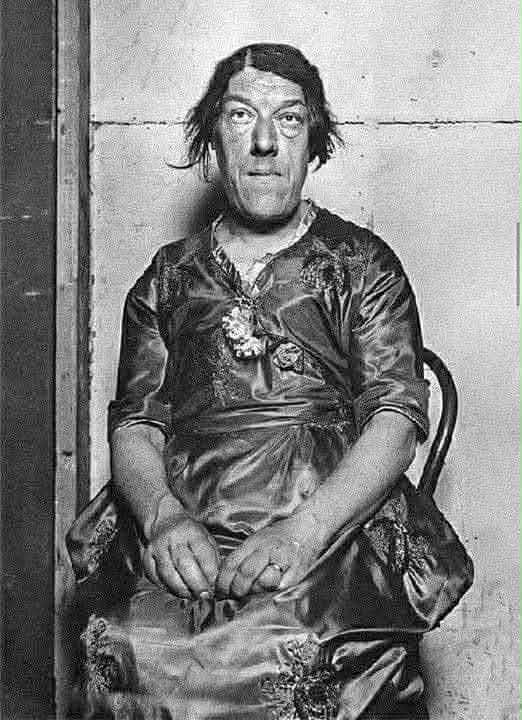
The story of Mary Ann Bevan is often remembered through a single photograph, but her life was far richer, more courageous, and more complex than any image suggests. She lived at a time when differences in appearance were met with cruelty rather than understanding, and yet her journey reflects remarkable strength and love. Born on December 20, 1874, in Plaistow, East London, Mary grew into a confident young woman with a promising future. She became a skilled nurse, admired not only for her abilities but for her kindness and striking appearance. In 1902, she married Thomas Bevan, building a loving family and welcoming four children. Life seemed full of possibility until tragedy abruptly altered its course—Thomas passed away just fourteen years later, leaving Mary to navigate a world with limited support for widowed mothers.
While adjusting to life as a single parent, Mary began to experience mysterious symptoms that gradually altered her physical appearance. At a time when medical science was still in its early stages, she had no understanding of the condition that was changing her face and body. Today, we know she suffered from acromegaly, a hormonal disorder caused by excessive growth hormone in adulthood. Without treatment options available, her features grew more pronounced, and her employment opportunities diminished. The condition not only affected her health but cost her the nursing career she relied on—a devastating setback for a woman responsible for four young children.
Faced with mounting financial pressure, Mary made a decision that has often been misunderstood. She responded to a job advertisement seeking individuals with unusual physical characteristics to perform in traveling shows. The choice was not driven by ambition or desire for attention—it was driven by necessity and maternal responsibility. Contemporary accounts describe her not as a figure of ridicule, but as a dignified and resilient woman determined to earn enough to secure her children’s future. Her work eventually took her to the United States, where she performed at Dreamland Circus in Coney Island. Although the environment could be harsh, it provided the income she needed to keep her family stable and educated.
Mary’s story eventually reached the attention of Dr. Harvey Cushing, a pioneering neurosurgeon whose research helped identify her condition. He expressed compassion for her circumstances and emphasized that her appearance was the result of a medical disorder rather than something deserving of mockery. After years of sacrifice, Mary returned to England, having successfully financed her children’s schooling. She passed away at 59, and her final wish—to be buried in her homeland—was honored. Today, Mary Ann Bevan is recognized not for the cruelty of the world around her, but for the extraordinary resilience, love, and dignity she demonstrated. Her legacy remains a powerful reminder that strength often shows itself most profoundly in quiet acts of devotion.