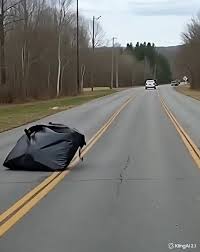
The sun was just beginning to dip toward the horizon, casting long, amber shadows across the asphalt as we wound our way through the countryside. It was a Sunday—the kind of day that usually hums with a quiet, domestic serenity—and my husband and I were taking full advantage of the calm. We were en route to his parents’ house, a drive we had made dozens of times, characterized by the steady hum of the tires and the rhythmic passing of telephone poles. There was very little traffic; the road stretched out ahead of us like a gray ribbon, occupied only by a single sedan a few hundred yards in front of our bumper.
For a few miles, we simply followed the lead car, maintaining a respectful distance. The driver seemed strangely erratic, slowing down and then speeding up without apparent reason. My husband gripped the steering wheel a little tighter, his intuition sensing something off-kilter about the vehicle ahead. Then, without warning, the passenger-side window of the sedan slid down. A large, overstuffed black trash bag was thrust out into the air. It hit the shoulder of the road with a sickening thud, tumbling several times before coming to a rest in the gravel. The car didn’t slow down; instead, the driver floored the accelerator, the engine roaring as they vanished into the distance, leaving behind nothing but a cloud of exhaust and a discarded piece of plastic.
“Did they really just litter like that?” I muttered, my indignation rising. But as we drew closer, the irritation transformed into a cold, visceral dread. The bag wasn’t lying still. It was shifting. A series of sharp, jerky movements strained against the reinforced plastic, and for a fleeting second, I thought I saw the silhouette of a limb pressing against the interior.
My husband didn’t need to be told to stop. He slammed on the brakes, the car skidding slightly as he pulled over onto the shoulder. The silence that followed was deafening, broken only by the ticking of our cooling engine. He stepped out of the car, his face set in a grim mask of determination, while I sat frozen in the passenger seat, my heart hammering against my ribs like a trapped bird. I watched through the windshield as he approached the bag. He hesitated for a heartbeat, perhaps fearing what he might find inside, and then he reached down and tore open the heavy-duty plastic.
The sound he made was a choked, strangled gasp. He stepped back, his hand over his mouth, and that was when I finally found the strength to open my own door. I stumbled out onto the gravel, the wind whipping my hair across my face, and peered into the opening of the bag.
There, shivering amidst the darkness of the plastic, was a creature that barely looked like a dog. It was a small terrier mix, so emaciated that its ribs stood out like the hull of a wrecked ship. Its fur was a matted, filth-caked mess of gray and white, and its eyes—wide, cloudy, and filled with a profound, soul-crushing terror—stared up at us as if expecting another blow. The smell that wafted from the bag was a pungent mix of waste and neglect, a testament to a life spent in a corner of the world where mercy did not exist.
For a long moment, none of us moved. Then, the little dog did something that shattered my heart into a thousand pieces. Despite the fact that it had just been flung from a moving vehicle like a piece of refuse, it let out a tiny, tentative whimper and dragged itself toward my husband’s boots. It didn’t growl; it didn’t snap. It simply rested its chin on his shoe and let out a long, shuddering sigh, as if it had finally decided that the struggle to survive was over.
“How could someone do this?” I whispered, the tears finally breaking through. “How do you look at something so small and decide it’s trash?”
The anger that had been simmering in my chest was replaced by a singular, focused mission. We couldn’t just leave him here, and we couldn’t just drop him at a pound where he might be overlooked. My husband gently lifted the dog—who weighed no more than a few bags of flour—and wrapped him in an old fleece jacket from our backseat. We turned the car around, the visit to the in-laws forgotten, and raced toward the nearest emergency veterinary clinic.
The next few hours were a blur of fluorescent lights, the smell of antiseptic, and the soft voices of technicians. The vet confirmed our worst fears: the dog was severely malnourished, dehydrated, and suffering from a systemic infection that had likely been festering for months. The act of being thrown from the car had resulted in several deep bruises and a hairline fracture in his front leg, but miraculously, he had survived the impact because the bag had caught a patch of tall grass before hitting the gravel.
As we sat in the waiting room, we made a decision. We didn’t know his name, and we didn’t know his history, but we knew his future. We named him Lucky—a name that felt both ironic and deeply true.
Over the coming weeks, our home transformed into a makeshift recovery ward. Lucky spent the first few days huddled in a corner of the laundry room, flinching at the sound of a raised voice or the clatter of a fallen spoon. But slowly, the Matting was shaved away, revealing a sleek, resilient little dog underneath. The terror in his eyes began to fade, replaced by a cautious curiosity. He learned that the sound of a crinkling bag meant treats, not a prison, and that a hand reaching toward him was meant for scratching ears, not for causing pain.