In several lakes across Oklahoma, residents have recently noticed unusual jelly-like formations attached to submerged branches and underwater structures, leading to widespread curiosity and online discussion.
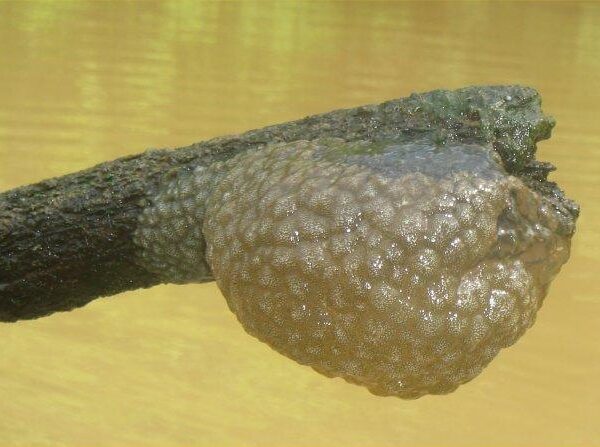
The appearance of these soft, clustered masses has prompted some people to describe them as “alien egg pods,” especially when first encountered in large groups near the water’s surface.
Photos and videos shared on social media quickly amplified interest, with many viewers expressing surprise at how unfamiliar these natural formations appeared in local freshwater environments.
While the visual impact can be unsettling at first glance, wildlife experts have confirmed that these structures are completely natural and have been observed in freshwater systems for a long time.
Identification and Official Explanation
State wildlife specialists have identified these formations as bryozoans, which are colonial aquatic organisms commonly found in lakes, ponds, and slow-moving freshwater habitats.
Officials have clarified that bryozoans are not harmful to humans, pets, fish, or the surrounding ecosystem, and they do not indicate pollution or environmental danger in the water.
Their presence is often associated with relatively healthy aquatic conditions, where water quality supports the growth of small filter-feeding organisms
Public statements from wildlife authorities emphasize that there is no need for concern if these jelly-like structures are encountered during recreational activities such as swimming or boating.
What Bryozoans Actually Are
Bryozoans are tiny invertebrate animals that live together in colonies, with each individual organism known as a zooid measuring only a few millimeters in size.
Their unusual appearance often leads to confusion because the colonies can look like eggs, slime, or artificial materials floating beneath the water.
An Ancient and Long-Existing Life Form
Bryozoans are not a new discovery in biology; they are part of a group of organisms that have existed for hundreds of millions of years in aquatic ecosystems.
Their evolutionary history extends back to ancient geological periods, making them one of the long-surviving forms of colonial life in freshwater and marine environments.
Their evolutionary history extends back to ancient geological periods, making them one of the long-surviving forms of colonial life in freshwater and marine environments.
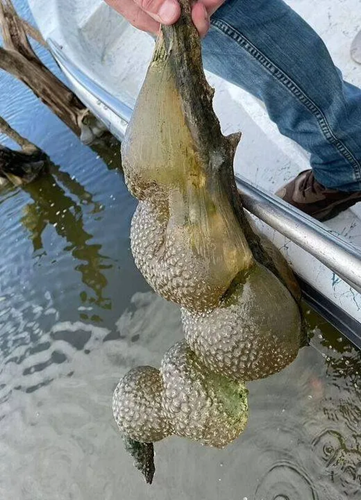
As the colony expands, it develops a soft, rounded structure that can vary in size depending on environmental conditions such as temperature, nutrients, and water flow.
These colonies often attach themselves to stable underwater surfaces like wood, rocks, docks, or aquatic plants where water movement is gentle
Over time, the accumulation of zooids creates the distinctive clustered appearance that attracts attention when colonies become large enough to be seen easily.
Texture, Structure, and Physical Appearance
The jelly-like appearance of bryozoan colonies is caused by their outer protective material and the soft gelatinous matrix that holds the colony together in water.
When submerged, the colonies appear smooth and flexible, giving the impression of floating organic masses attached to underwater structures.
Once removed from water, the texture can change and become firmer or more compact, depending on moisture levels and environmental exposure.
This transformation often increases public confusion, as the colonies can look significantly different in and out of water.
Comparison to Coral-Like Organisms
Bryozoans are sometimes compared to coral because both form colonies of small organisms that function together as a larger structure.
However, unlike coral reefs, which form strong calcium-based structures, bryozoan colonies are far more fragile and temporary in nature.
They do produce structural materials in some species, but these formations are not long-lasting reef systems and tend to break down seasonally.
This makes bryozoans more transient and closely tied to seasonal changes in freshwater environments rather than permanent underwater architecture.
Ecological Role in Freshwater Systems
Despite their unusual appearance, bryozoans play an important ecological role as filter feeders within freshwater ecosystems.
They consume microscopic particles such as plankton and organic debris suspended in the water, helping to maintain clearer and more balanced aquatic conditions.
Their filtering activity contributes to nutrient cycling within lakes, indirectly supporting other aquatic organisms that depend on stable water quality.
Species such as small fish, insects, and other invertebrates benefit from the ecological balance maintained in part by bryozoan activity.
Seasonal Growth and Life Cycle
Bryozoan colonies tend to grow most actively during warmer months when water temperatures and nutrient availability support rapid biological activity.
As temperatures drop, colonies begin to decline and eventually die off, leaving behind specialized survival structures known as statoblasts.
These statoblasts are resilient reproductive units that allow bryozoans to survive unfavorable conditions such as winter or drought periods.
When environmental conditions improve again, typically in spring or early summer, new colonies develop from these structures, continuing the life cycle.
Public Reaction and Misinterpretation
The unusual appearance of bryozoan colonies has led to a wide range of public reactions, particularly among individuals encountering them for the first time.
Some observers express curiosity and scientific interest, while others initially react with discomfort due to their unfamiliar and organic appearance.
Social media discussions have amplified both fascination and humor, with some users jokingly referring to them as “alien eggs” or unknown biological formations.
These reactions highlight how unfamiliar natural phenomena can quickly be misinterpreted when viewed outside of scientific context.
Distribution Across the World
Bryozoans are not unique to Oklahoma and are found in freshwater systems across many regions of the world, including North America, Europe, and Asia
They are absent only in extreme environments such as Antarctica, where water conditions are too cold and unstable for their survival.
Their spread between water bodies can occur naturally through connected waterways or indirectly through wildlife movement.
Birds and aquatic animals may also contribute to dispersal by carrying microscopic stages of bryozoans between ecosystems.
Importance of Awareness and Education
The discovery of bryozoan colonies in public lakes highlights the importance of environmental education in helping people understand freshwater biodiversity.
Many aquatic organisms remain unnoticed until they grow large enough to become visible, at which point they may appear unfamiliar or unusual.
Public awareness can reduce misinterpretation and encourage appreciation of the complex ecosystems that exist beneath the surface of everyday environments.
Understanding these organisms helps promote respect for natural habitats and reduces unnecessary concern when encountering unfamiliar but harmless species.
Conclusion: A Natural Phenomenon, Not a Threat
Although bryozoan colonies may appear strange or otherworldly at first sight, scientific evidence confirms they are a normal and harmless part of freshwater ecosystems.
Their presence in Oklahoma lakes reflects natural biological processes rather than environmental danger or contamination.
What initially seems unusual or alarming is, in reality, an example of ancient and ongoing life quietly sustaining aquatic environments.
These formations serve as a reminder that freshwater ecosystems contain far more diversity and complexity than is often visible at the surface.